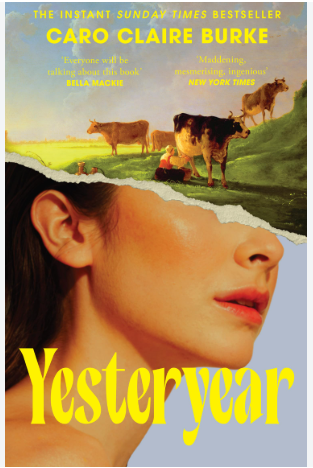
I finished reading Yesteryear[1], by Caro Claire Burke, in one fell swoop of desperation. I only stopped to sleep past 2am, totally absorbed in what felt like a chemical addiction to each new scene, each new sentence, each new word. Burke’s erratic writing style and structure means that every line is a revelation, jumping between past, present and future; between first-person narrative, interviewer questions, and Instagram comments; between internal monologue and externalised expression. Every word is important in some way, and reading the novel end-to-end feels like making a murder wall, tacking up photos and newspaper excerpts, connecting them with red string and paranoid suspicion.
The fractured chronology of the narrative reflects the timelessness of the patriarchy, reminding us that no matter how far from the 1850s we are, women’s rights are as dependent on their protection as their introduction. The main lessons I learnt from this book revolve around the fundamental performativity of gender roles and the power imbalance of choice feminism.
The philosophy that gender is a performance can be traced back centuries, but it is perhaps most concretely explained by Judith Butler. In their 1990 book Gender Troubles, Butler explains that gender can be seen as a repetitive performance of actions that creates a certain identity, rather than gender being an intrinsic personality trait. For example, the clothes that we wear indicate which gender we belong to, like skirts, makeup and heels, but a woman wearing trousers, no makeup and trainers is clearly no less of a woman.
This social lens can be directly applied to Yesteryear, where Nathalie and Caleb live their marriage through increasingly strict performances of their assigned gender roles. They are essentially adults playing house.
Nathalie is the perfect wife, smiling, sweet and childbearing. Except that she has nannies to help her raise the children, she has to remind herself to smile even when she is unhappy, she is regularly rageful, and she experiences severely painful symptoms of postpartum depression.
Caleb is the perfect husband, loyal, a provider, a disciplinarian. Except that he has an affair, is largely unemployed, and later beats and rapes his wife. The producer he has an affair with is fourteen years younger than him, and he later blames his wife for not pretending to enjoy sex with him. He is unemployed not because of economic reasons, but simply because his parents, to whom he shows no gratitude, pay for everything for him.
His ideal jobs are far removed from his reality and firmly positioned in an idealised notion of his own masculinity, suggesting blacksmith, soldier and cowboy when asked. When they buy Yesteryear Farm, he is unable to produce anything off the land because he has none of the required skills or information, seeing it purely as an aesthetic that supports his own gender performativity. When his failure to farm anything risks hurting his views of masculinity, he instead buys produce from the supermarket and lies to his wife about having grown it himself.
It is easy to read Yesteryear as a critique of the performance of femininity, but it is Caleb’s internet forums that push him further into the manosphere, telling him that he needs to discipline his wife, that he is the head of the household, that there are fundamentally more ‘feminine’ tasks that Nathalie should do.
“I’m going to share a bed with you tonight.”
The smile slips off my face.
I won’t have any complaints about it, either,” he goes on. “You’re my wife, and I’m your husband, and we’re meant to share a bed.”
This includes his changed relationship with sex. At the start of their relationship, they both wait until marriage, and then have mutually unenjoyable sex that becomes timetabled for when Nathalie is ovulating. After a decade in the manosphere, Caleb now decides when they will have sex, whenever he wants it, regardless of Nathalie’s increasing fear of him.
Throughout the novel, the refrain “a man may work from sun to sun, but a woman’s work is never done, never done, never done” floats through the narrative periodically as a reminder to Nathalie of her duties. This line is commonly taken to refer to unpaid and unnoticed female labour, such as preparing the food and washing up the dishes before and after sunlight hours, or waking up in the night for crying infants. However, it also has a darker implication, that a woman’s work continues into nighttime, pointing to her marital obligation to give sex. When Nathalie is injured and in pain from the bear trap, Caleb effectively takes sex from her, thus claiming what he believes to be owed to him.
When Nathalie is effectively in command of their relationship, the gender norms that they perform are merely that: a performance. When Caleb struggles to find direction, Nathalie and his father come up with plans for him and then let him believe they were his own ideas. When Caleb struggles to make plants grow, Nathalie employs undocumented migrants to do his hard labour while letting Caleb believe he is a provider. When Caleb’s crops die, she asks the workers to spray them with pesticide without Caleb knowing, so that his feelings are not hurt over his failure.
However, when they move into the 1850s renovation of Yesteryear Farm, Caleb has been radicalised by the manosphere and claims full control over his wife, both financially and interpersonally. The gender roles are no longer a performance of feminine submission and masculine domination, but a tangibly imbalanced relationship in which an adult woman is reduced to chattel. Their performance of gender thus crosses the line rapidly from aesthetic to abusive, as soon as the perceived power dynamics inevitably become a reality.
“Maybe I’m not interested in that anymore.”
Old Caleb raises a hand swiftly into the sky. I close my eyes. I’m so prepared for the thunderclap of pain that it takes me a moment to realise the moment has passed. I open my eyes, watch his hand push back his hair in agitation. He didn’t hurt me again, he can always hurt me again, he will eventually hurt me again. A sob escapes me. I’m so tired of this place. “Why am I here?”
“You’re here because this is where you want to be,” he roars.
“Well, now I want to leave,” I cry out. “Now I want to go home.”
This leads me to my second point, about choice feminism: choice only exists when the other options remain readily available. As Paris Mwendwa summarises, “centring women's choice can never be productive if the context that informs women's choices is not also considered.”[2] For Nathalie, her context is a rigorous, oppressive religious background that leads both her and her sister to marry abusive men rather than question Christian teachings on female autonomy.
When Nathalie is at Harvard, her choice to avoid parties and study hard is not one that anyone could justifiably criticise. It is her hard work and intelligence that has given her the full scholarship, and her desire to avoid partying stems as much from her religion as from her gratitude for the opportunity.
But her choices become more and more strained as her path into the trad-wife life continues, until her so-called ‘choices’ appear more to be agreement with a situation that already exists and has been decided for her. When her and Caleb buy Yesteryear Farm, his father insists that it be solely in Caleb’s name. Suddenly her choices are no longer reversible because there is no longer any alternative. Thus they can no longer be deemed choices. To quote a regularly cited line in response to stay-at-home girlfriend posts: she is effectively “one argument away from being homeless.”[3]
She wants one baby and struggles with postpartum, asking her mother if she can have some help. Instead, her mother tells her to go on a post-surgery run which leaves her bleeding down both legs, tells her everyone knows how to be a mother so she should just deal with it herrself, and with input from Caleb’s parents she ends up having a total of eleven children.
Caleb points out that as they have the same goals, she has no need for money of her own. After a quick call to the bank, all her money is siphoned into the joint account which lands under Caleb’s name, even though she is by far the main breadwinner. The ‘choice’ to get a divorce is therefore barely a viable option. Not only does it go against her beliefs and identity as a fundamentalist Christian woman, but it would also mean abandoning her children with a man who has never taken care of them and having no address and no bank account.
“Every payment from QuickCash for the last four months has gone into that account. Two hundred and twenty thousand in total.” He laughed. “That’s a whole lot of pregnancy brain!”
I was feeling very cold now.
“Anyways. They’ve fixed it, so the money will go straight into our official LLC account from now on.”
“Thank you so much for – clearing that up. Do you know – I’m just going to go to the bathroom for a moment –"
Her performance of constant submission is only beneficial when it has a paying audience. As soon as the cameras are off, when her family falls from grace and she deletes her influencer account, when she no longer has the right-wing rallies full of people complimenting her on being a role model, there are no positives left. Her choice to revert to traditional gender roles and revert hundreds of years of progress for women results in just that: a life before hundreds of years of progress for women. In other words, no choice at all.
Ultimately, Yesteryear is not a book criticising women for wanting organic food and a family. Similarly, it is worlds apart form taking a postpartum career break to look after your children without burning out. Rather, it deconstructs the harmful structures by which women already live, and how easily we can be radicalised into pursuing paths that harm us. It underlines that willingly removing our own independence and autonomy is not an aesthetic, but a prison sentence in favour of a husband, who, as this book shows us, has a lifetime to change into someone you no longer recognise.
[1] Caro Claire Burke, Yesteryear, (2026, 4th Estate, London), https://www.waterstones.com/book/yesteryear/caro-claire-burke/9780008742768
[2]Paris Mwendwa, ‘Choice Feminism Is Popular Because It Does Nothing for Women’, (26 February 2026), Substack, https://parisgitobu.substack.com/p/choice-feminism-is-popular-because
[3] Desiree Peralta, ‘Why You Should Not Be a Stay-At-Home Wife’, (26 June 2026), Medium, https://medium.com/publishous/why-you-should-not-be-a-stay-at-home-wife-af557171ce35