The Cornell University gang rape is not an isolated incident – neither in US frat culture, nor in the global epidemic of violence against women. Any woman could tell you that, and indeed, that is why it is so important.
The case itself refers to a young woman at a frat party who was drugged and sexually assaulted by 7 men, who subsequently advertised her to 54 more citing “free pussy” (Qusba, 2026).[1]The victim, anonymised by the pseudonym ‘Jane Doe’ for her own protection, disclosed to the university, who meted out a range of punishments in response: expulsion of two students, suspension of two others, a campus ban for a student who had already graduated, and “reflection papers” for the two remaining students subject to a No-Contact Order between them and the victim (Qusba, 2026).[2]The latter is perhaps a familiar outcome for many survivors of sexual misconduct in academic institutions where ‘bright futures’ are to be protected at all costs, particularly where that cost is female.
This case has crossed the Atlantic in making international headlines due to the attention garnered not just by the facts, but by the name-dropping of the men involved by Cornell’s independent student newspaper. The case has gathered into a legal maelstrom comprising a Title IX civil case, a pending criminal case, the New York Attorney General standing against the former Deputy US Attorney General, countersuits from the boys, a firing from Wells Fargo, calls to reveal Jane Doe’s identity from men, refusals from women everywhere, and early-decision applications to Cornell being retracted. Not to mention the poorly instructed legal advice on Reddit about US defamation law by young men who are yet to go to law school but eager to declare that rape cases are really a crime against men.
But besides the disturbing details of this specific attack, the common threads between Jane Doe’s case and countless others’ remind us of the universality of the global female experience, despite the uniqueness of each struggle. In the same period, violence against women around the globe has included the discovery of 12 women’s bodies in South Africa over just 2 months in one same region (Ngcobo, 2026)[3]. In New South Wales in Australia, 3 different women ranging in age from 23 to 90 were killed by men known to them, all within 24 hours (The Guardian, 2026).[4]Meanwhile, in the UK, a 14-year-old girl was stabbed by a boy in her class for not wanting to be his girlfriend, and this month, the judge gave him a 3-year restraining order instead of prison time (Lamdin, Mace & Swallow, 2026).[5]In short, for a case that revolves around a frat house, there are a staggering amount of women involved: both reflected in the recurrent violence, but also in finding a solution.
The victim herself, Jane Doe, faced horrendous dehumanisation both in the house and in the fated group chat through which her assault was advertised. Furthermore, since the backlash (pronounced ‘legal repercussions’) against the accused, men online have tried to bully the name of the victim out of those involved, thus not only violating her privacy but exposing her to very real physical danger in retaliation for her speaking out. Despite this, she found the strength to demand better, to bring a case against those who abused her, and against those who tried to cover it up.
Following her guidance, every day more women are lacing up their boots to get on the scene, doing their part the way they know how.
In student journalism, when the university chose to protect the identities of those involved in the gang rape of a student, the Cornell Daily Sun broke the story in solidarity with the victim. In a powerful article about responsibly and accountability, they underline that:
“A university's obligation to the physical safety of its students is not one commitment among several, to be weighed against reputation or litigation exposure. It is antecedent to everything else the institution does. Cornell exists to teach and to educate, and instruction presupposes a student capable of receiving it, which presupposes, in turn, a student who is not afraid to attend their lecture hall. Safety is not adjacent to the educational mission — safety is, in fact, its precondition.” (Dasser et al., 2026)[6]
The editorial team who wrote these impactful words comprises five students, four of whom are women. This highlights the strength and grace that comes from enacting solidarity with other women. In this case, recognising a fellow student’s pain, and taking personal ownership of their individual responsibility, has sparked a global conversation about campus rape that now cannot be put out.
In law, the case now has as special prosecutor New York’s Attorney General, Letitia James, whose numerous accolades include being public defender for the Legal Aid Society for those who cannot afford a lawyer; passing the Safe Housing Act to hold landlords accountable for keeping vulnerable tenants in inhumane housing conditions; tackling the gender pay gap by banning employers from asking about applicants’ wage history; passing more legislation than all previous Public Advocates combined; and successfully fining more than $9 billion out of corporations, landlords, opioid manufacturers and neglectful care homes that can instead be invested into the public (Office of the New York Attorney General, 2026).[7]Her appointment to the case brings both expertise and hopefully justice. Engaging the highest-ranking legal official of New York also affords the case credibility, which can unfortunately be a crucial tenet of success in a so-called “he-said-she-said” case, a term often used to describe sexual or domestic offences on account of the low likelihood of hard evidence.
In government, the Governor of New York, Kathy Hochul appointed James to replace the original prosecutors in whom she had “lost faith”, stating that “this young woman had already endured something that is utterly unspeakable, and then at every turn she was failed by people and institutions with an obligation to protect her.” As a legacy of this investigation, Hochul also vows to take this one step further and protect future victims of sexual assault from a loophole in the legislation that states that voluntary intoxication may provide a defence for the accused. She argues, correctly, that "voluntary intoxication is not a licence for gang rape” (Matza, 2026).[8]In this regard, New York attorneys paint a complex story of the current state laws on voluntary intoxication and the current threshold of “incapacitation” to statutorily negate implied consent. Some prosecutors argue the threshold should be lower, suggesting that if you are too intoxicated to legally drive a car, you should be deemed too intoxicated to consent; meanwhile some defence attorneys argue the law does not need amending, pointing to rape cases where voluntary intoxication did not prevent a conviction (Halpert, 2026).[9]Therefore, not only is the case being handled by women, for women: it is also creating a legacy for future women to protect their safety.
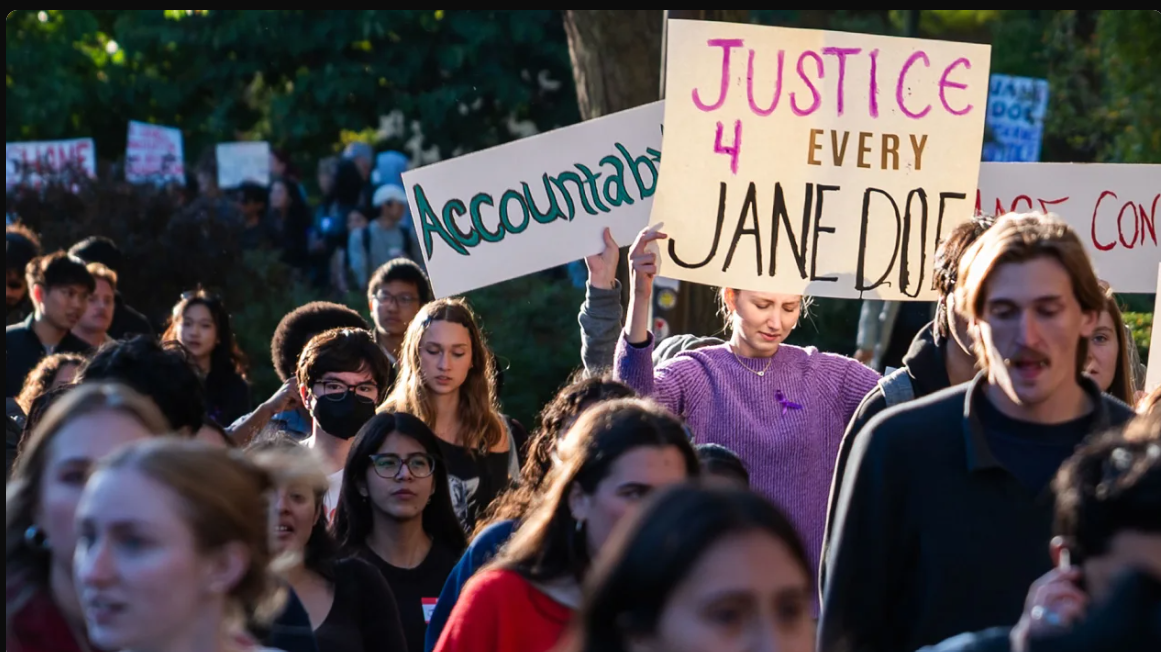
In cities across the US and throughout the world, women are holding ‘I Am Jane Doe’ protests calling for the protection of the victim’s identity amongst so many death threats, rape threats and attempts to dox her online by men seeking revenge (Tsvetkova, 2026).[10]Thousands of women have taken to the street, not because they know this Jane Doe, but because they know a Jane Doe – every woman does. The bravery of one woman lit the spark, and the solidarity of countless more is what has kept the fire going.
In conclusion, solidarity with the struggle of other women is not just a part of feminism, it is integral to the female experience. Going to the toilet as a group, slipping a pad under the door, braiding hair and piercing ears, the whispered magic of sleepovers and secrets – as girls, we reach out to one another to form these connections. As women, we retain this power through the ability to stand shoulder-to-shoulder with a stranger and know that we are on the same side, even if we never cross paths again. We stand up for women we will never know, on behalf of women we have never met. We follow someone’s mother who walks ahead of us, and lead someone’s daughter we never knew was behind us. We recognise Jane Doe in each of our neighbours, because we know we carry the flame for someone other than ourselves.
[1]Qusba, C., ‘Cornell, Chi Phi Sued by Victim of Alleged Gang Rape, Drugging in 2024’, Cornell Daily Sun, Sep 18th (2026) https://www.cornellsun.com/article/2026/09/tccsuykuvb4z
[2] Qusba, C., ‘Records Reveal Cornell’s Punishments for Seven Chi Phi Defendants’, Cornell Daily Sun, Oct 5th (2026) https://www.cornellsun.com/article/2026/10/records-reveal-cornell-s-punishments-for-seven-chi-phi-defendants
[3]Ngcobo, K., ‘Twelve Women Have Been Killed in One Part of South Africa Since July. Here's What We Know So Far’, BBC (2026) https://www.bbc.co.uk/news/articles/c6m27dprvzv7o
[4] ‘Three Men Charged with Domestic Violence-Related Murders After Three Women Killed in Separate Incidents in NSW’, The Guardian (2026) https://www.theguardian.com/australia-news/2026/sep/20/bondi-stabbing-90-year-old-woman-nsw-alleged-domestic-violence-killings-ntwnfb
[5]Lamdin, F., Mace, C., Swallow, B., ‘Mother Wants Justice After Boy's 'Evil' Knife Attack on her Daughter’, BBC (2026) https://www.bbc.co.uk/news/articles/c5398n821rlko
[6] Dasser, S., Romanov Imber, S., Cheek, Z., Zhou, R., ‘Cornell Won’t, We Will’, Cornell Daily Sun (2026) https://www.cornellsun.com/article/2026/09/editorial-cornell-won-t-we-will
[7] Office of the New York Attorney General (2026) https://ag.ny.gov/about/meet-letitia-james
[8]Matza, M., ‘Woman at Centre of Cornell Rape Inquiry Was 'Failed' by Officials, Says New York Governor’, BBC (2026) https://www.bbc.co.uk/news/articles/cqvg04718lr9o
[9] Halpert, M., ‘Drinking and Consent - Cornell Rape Allegations Expose 'Loopholes' in Laws’, BBC (2026) https://www.bbc.co.uk/news/articles/c9e8l0ep8d1mo
[10] Tsvetkova, M., ‘Protesters Stage 'I Am Jane Doe' Rally in New York City Against Sexual Violence’, Reuters (2026) https://www.reuters.com/legal/government/protesters-stage-i-am-jane-doe-rally-new-york-city-against-sexual-violence-2026-10-08/