046 - Style Over Substance: On Vanity, Conformity and the Illusion of Empowerment - by Camille Saunders
From beauty standards to personal branding, we have become remarkably good at mistaking conformity for liberation.
I recently finished watching Inventing Anna, Shonda Rhimes’ 2022 mini-series about the rise and fall of convicted felon Anna Sorokin. The crimes she commits are multi-million dollar frauds against banks and private loan companies, as well as defrauding her friends and all those who help her, all in the name of building up her so-called ‘business’, and more realistically, her ‘brand’. Throughout the series, we regularly see her portrayed as selfish, self-absorbed and obsessed with her own image. As close to a real-life Narcissus as is possible.
I watched the characters of her friends, journalists and defence lawyers increasingly lay their own lives on the line for her, and cater to her petulant demands about clothes, style and attention. At one point her entitlement leads her to wait for 5 hours in the lobby of her personal trainer’s hotel hoping she can manipulate her into letting her in for free.
But what struck me by the end was an overhanging question of what would this look like just 4 years later in 2026? Would she seem crazy, or just an average influencer? Or even just an average person who got carried away?
The cold reality is that many snippets of the series I recognise from people I have met in real life. From running up a tab in my name, to faking tears, to petty theft and academic misconduct, the examples could fill a page.
From these interactions to the screen in Inventing Anna, the behaviour is exactly the same. Project a certain image, and nobody will check if what seems to be reflected is truly there. The embodiment of style over substance.
In Anna’s world, the ‘fake it til you make it’ approach leads to prison time. It is also a lesson that what you make up in your head is not reality.
The path is becoming a well-trodden one, as seen in the Guardian article titled ‘30 Under 30-Year Sentences’[1]highlighting how many of those on the highly acclaimed 30-under-30 list at Forbes turn out to be fraudulent and face real, criminal repercussions for grossly inflating their skills, prowess or funds.
Charlie Javice, a tech CEO, was sentenced to 7 years in prison for $175M fraud after inflating her client numbers from 300,000 to 4,000,000 to JP Morgan in the hope they would buy the company.[2]
Sam Bankman-Fried, a crypto CEO, was sentenced to 25 years in prison for crimes that ranged from defrauding investors out of $3B to illegal political donations and bribes to foreign governments.[3]
Martin Shkreli, a pharmaceuticals CEO, was sentenced to 7 years in prison for stealing $11M from his company to pay back investors to whom he had lied about funds. He also bought the rights to a life-saving HIV medication and raised the price from $13 per pill to $750, literally placing his own gain above the lives of others.[4]
Meanwhile, the curtain is falling from other areas of deceit. Just this week, the seemingly untouchable world of technology saw Mark Zuckerburg in court, agreeing to up to $18B to settle claims from 29 US states that his products harm children.[5]
Through this lens, we can easily see that faking parts of your identity to appear better than reality is problematic.
When applied to looks, it was once called narcissism. Now we call it ‘wellness’ and assure ourselves it is not fundamentally based in patriarchal expectations of feminine perfection.
For a while, there was a movement of thought turning to Disney films to exemplify the negative body image we were fed as young children. Be the skinny-waisted ingenue with tiny feet and your prince will come. Be plus-sized and you may as well grow tentacles and live under the sea with your pet eels.
Turning away from this subliminal messaging is a crucial turning point in our personal education. However, the plus-size to villain pipeline theory only works when implied into relatively few Disney films, like the Little Mermaid or Alice in Wonderland. Meanwhile, in focussing on what is unsaid and implied, we are forgetting the actual lessons taught in these children’s stories: to distrust those who care more about presenting their worth on the outside than nurturing it on the inside.
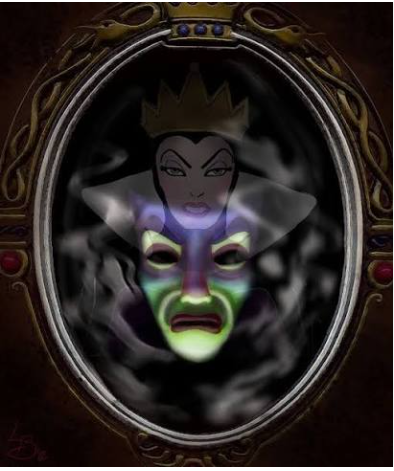
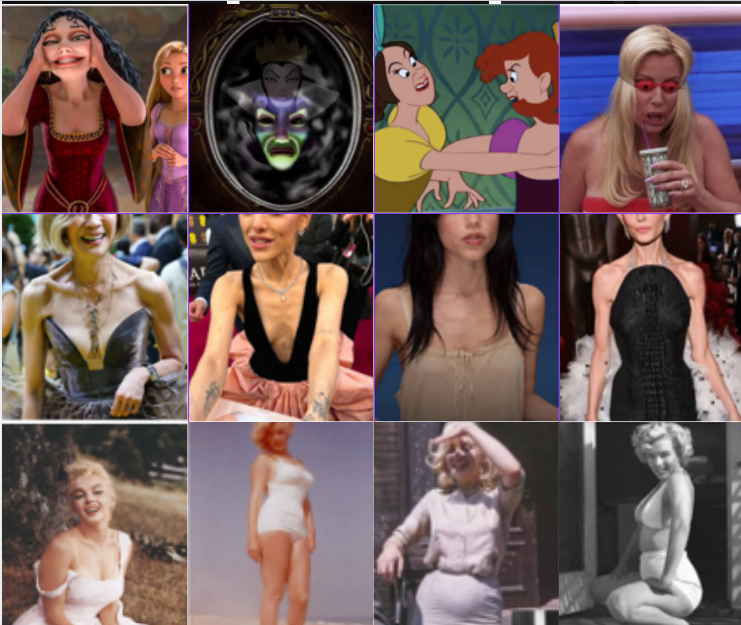
In the story of Snow White, the Queen’s central characterisation is her vanity. She obsessively seeks reassurance in the mirror, turning to her own reflection for validation of self. In repeatedly asking the mirror, ‘who is the fairest of them all?’ her need to be perceived as beautiful manifests itself as a masculine-presenting disembodied head, the very personification of the male gaze. Yet there are few, if any men in Snow White. The Queen has no interest in the prince, and Snow White’s father is long dead. Her vanity therefore outlasts the confines of masculine perception and manifests itself firmly in her own self-image. The violence she later enacts on Snow White has nothing to do with a man, and everything to do with her obsession with her own beauty. Vanity is therefore canonically the moral failing warned against in this story.
Likewise, in the film Tangled, Mother Gothel’s control of her daughter is based solely in her own narcissism. In this case, it is rooted in a desire to recapture her youth and deny the natural course of ageing. Her obsession leads to the kidnapping of Rapunzel as a baby so that she can artificially look young forever. Once again, her fixation on altering her looks is central to her villain arc.
The so-called ‘ugly stepsisters’ of Cinderella are likewise presented as shallow and vain because of their toxic self-image, not simply evil because of their bone structure. In the original stories, they perform grotesque cosmetic surgery on themselves to physically fit into the box of a different physique, materialised in the form of Cinderella’s shoe. This moment was taken up by the 2025 film The Ugly Stepsister, an uncomfortable body horror about Cinderella’s stepsibling physically harming herself into beauty conformity. She swallows a tape worm egg to starve herself into her skinniest weight, covering her subsequent health-related hair loss with wigs. She has a brutal nose job that leaves her permanently deformed, and has fake lashes sewn directly into her eyelids. Her pain and suffering in pursuit of a specific, unnatural beauty standard is one painfully close to reality, and highlights the wider contexts of how cosmetics are foisted on women. Two particularly insightful articles are ‘The Feminine Grotesque: The Ugly Stepsister and What Women Mean When We Say Beauty Is Pain’[6]and ‘Hunger, Beauty, and the Grotesque in The Ugly Stepsister’[7].
Even in spinoffs like A Cinderella Story, the stepmother Fiona is not established as the villain by being curvy, but by her constant focus on fad-diets and body-alterations. The skinny teas, the tan bed, the obsession with a salmon-based diet are all presented as conforming to patriarchal expectations instead of resisting against them.
In total then, the lessons we are taught from young is not necessarily that skinniness is aspirational, but rather that changing ourselves to conform to transient beauty standards is something worth fearing. Mother Gothel’s vanity lies in an obsession with youth; now a quarter of young women under 35 in the UK are interested in getting Botox[8]. Snow White’s stepmother’s vanity lies in her obsession with her own image; now estimates suggest that we spend on average 54 hours a year taking photos of ourselves, with 5 billion selfies taken daily worldwide.[9]The stepsisters’ vanity lies in their physical self-alteration; now 35 million aesthetic procedures are performed by plastic surgeons a year, with liposuction, breast augmentation, eyelid surgery, abdominoplasty and rhinoplasty the five most common alterations.[10]The Cinderella Story stepmother’s vanity lies in her consumption of fad diet foods and drinks; now some polls claim the average person tries fad diets 126 times over the course of their life.[11]Meanwhile extreme weight-loss medication like Ozempic, Wegovy and Mounjaro are bought 10 times more often privately than actually prescribed by the NHS, so for aesthetic reasons rather than medical.[12]This is further demonstrated by the fact that Type 2 diabetes is more often diagnosed in men, and yet 80% of these medication users are women.[13]An interesting article on this is ‘The Performance of Vanishing: Hollywood’s New Thin Obsession.’[14] As is shown below, we now live in a world where Marilyn Monroe, an icon of feminine beauty, would be considered plus-size compared to those on the red carpet today.
None of these observations are to shame or humiliate the women caught up in the statistics. To deny the wider context of the patriarchy would be to tacitly forgive it for the harm for which it is responsible. In no way do I mean to blame women for their own pain. For centuries, a woman’s attractiveness secured her financial stability, and it is only relatively recently that openly laughing at plus-sized women stopped being mainstream television. Shaming healthy women and girls about their weight has been a lucrative business for men for decades and has made for quick laughs in poorly written shows since the dawn of visual media.
However, to suggest that just because a standard is set by the patriarchy means that women are powerless to resist it is to represent women as too weak-willed and impressionable to partake in their own salvation. Resistance against unjust and unnatural portrayals of women are a crucial facet of the female existence. The age of body positivity is not just an aesthetic trend, but a moment of genuine empowerment, and is thus too important to discard so quickly.
Rebranding conformity to our own oppression as empowerment does not make it liberation; just as faking millions of clients or dollars in investment does not make them real. We have become so accustomed to oppressive power structures that we can mistake conformity to them for empowerment. And when we try to ‘win’ within unfair systems — whether capitalism or the patriarchy — what we gain may be little more than the illusion of victory.
by Camille Saunders
[1] https://www.theguardian.com/business/2023/apr/06/forbes-30-under-30-tech-finance-prison
[2] https://www.justice.gov/usao-sdny/pr/startup-ceo-charlie-javice-sentenced-85-months-prison-175-million-fraud
[3] https://www.justice.gov/archives/opa/pr/samuel-bankman-fried-sentenced-25-years-his-orchestration-multiple-fraudulent-schemes
[4] https://www.pbs.org/newshour/nation/court-upholds-sentencing-of-drug-company-ceo-martin-shkreli
[5] https://www.bbc.co.uk/news/live/cy5v0vrlp4xt
[6] https://angelicabastien.substack.com/p/the-feminine-grotesque-no2-the-ugly
[7] https://nobutlisten.com/2025/05/09/hunger-beauty-and-the-grotesque-in-the-ugly-stepsister/
[8] https://www.mintel.com/press-centre/forever-young-a-quarter-of-women-aged-18-34-are-interested-in-having-botox/
[9] https://photutorial.com/selfie-statistics/
[10] https://pubmed.ncbi.nlm.nih.gov/39103642/
[11] https://www.independent.co.uk/life-style/diet-weight-loss-food-unhealthy-eating-habits-a9274676.html
[12] https://creoclinic.com/blog/ozempic-glp-1-statistics/
[13] https://pmc.ncbi.nlm.nih.gov/articles/PMC10163139/
[14] https://www.irkmagazine.com/post/the-performance-of-vanishing-hollywood-ozempic-wants-women-to-disappear-again/