044 - Meals & Misogyny - by Inès N'Cib
Talking with friends recently I’ve noticed quite a few of us had stories about their family hiding snacks in inconspicuous places so that their brothers wouldn’t devour it all by themselves ; or even about being forbidden certain foods their brothers were allowed to eat.
Those instances reminded me that food is a topic so intimately conditioned by gender norms ; be it who cooks the food, who serves it, who eats first, who eats what…. Our relationship with food is a reflection of the power dynamics between the genders. All in all, it can even be considered that the kitchen is a reflection and representation of the way our society works (Narayanan, 2016).
In most cultures, women are the ones with the responsibility to prepare nutritious meals that suit everyone’s taste. Yet, women hold very little control over food supplies, and they often nourish themselves the least (Allen & Sachs, 2007).
Furthermore, women suffer the most from food insecurity in the world, which has been proven to exacerbate risks of gender-based violence (Abusbaitan et al., 2026).
Cooking, a gendered practice in a heteronormative world :
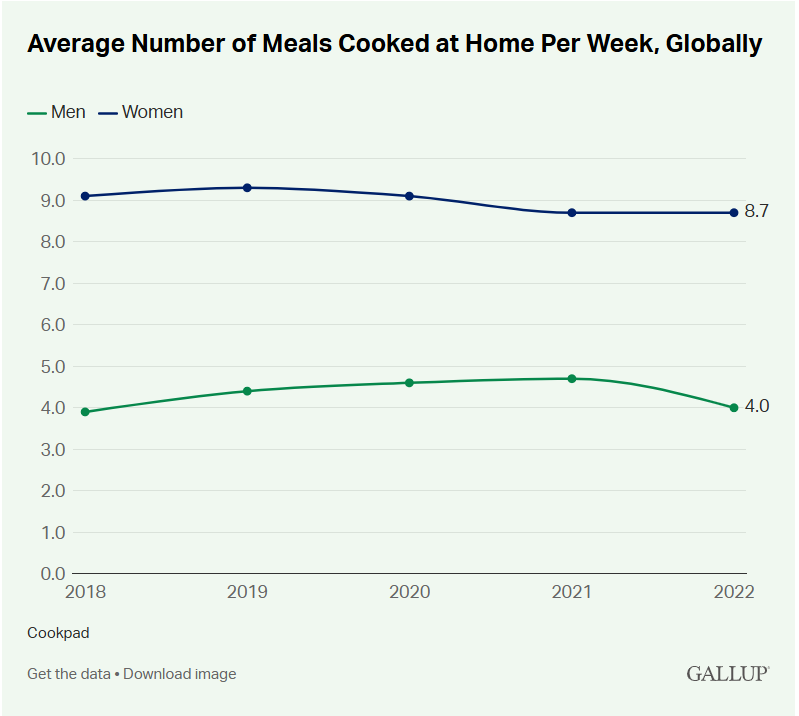
Without surprise, globally, women are the ones taking care of the cooking at home (Gallup, 2023). Cooking and serving the food is not only the physical labour of preparing it and cleaning afterwards, but also the mental weight of planning meals, managing food supplies, getting everyone to eat, …
Oftentimes, women don’t even consider their own preferences in meals, and prioritise the tastes of the other members of the household. Not priorising the husband’s taste, in particular, can often be the cause of arguments, and in the worst cases, domestic abuse.
Cooking is closely linked to the notion of femininity. Indeed patriarchy has created the romanticised image of the perfect woman, who spends her time in the kitchen cooking for her husband and kids. Learning how to cook is a rite of passage for little girls, it’s what allows them to truly “become a woman”. Not knowing how to cook is a flaw that makes them unsuitable for womanhood (Mauriello & Cottino, 2022).
In contrast, while cooking is acceptable for men, it is more seen as a favour they do for others, rather than a duty. Men’s cooking is an act visible in the public sphere, showcasted on tv and praised with awards. For example, until recent years, Food & Wine Best New Chefs have always been mostly men, and on average, more than 90% of Michelin restaurants are led by men (Chef’s Pencil, 2023).
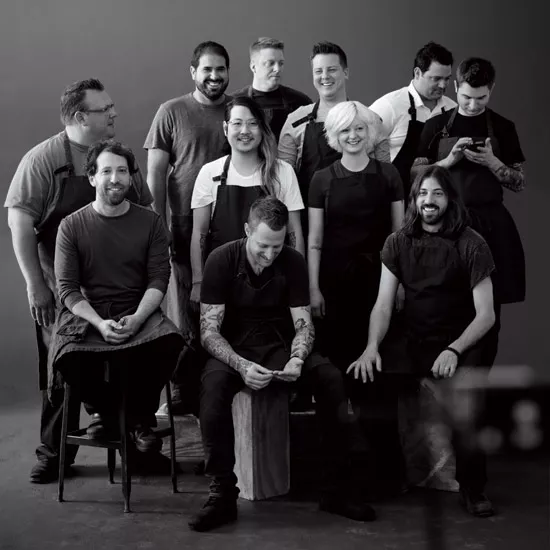
Food & Wine 2013 Best New Chefs.
On the other hand, women’s cooking is something that is confined to the private sphere, where their labour remains unrecognised.
The performance of eating :
The way we eat is not exempt from following the patterns of gender norms either. Indeed, our eating habits are impacted by what patriarchy has made us expect of femininity or masculinity, by consuming more “feminine” or “masculine” foods (McClintock, 2015).
Studies reveal that food behaviours vary depending on gender. Men tend to eat significantly larger quantities, and prefer red and processed meat, while women consume more vegetables (National Library of Medicine, 2024). This greener diet is due the fact that in a patriarchal society, women are expected to strive for thinness, in order to truly be considered feminine (Reiheld, 2012). This is why dieting and eating very little have always been associated with femininity (Cavazza, Guidetti & Butera, 2015).
Therefore what we eat is not only a question of giving our body what it needs to function, it also becomes a performance, via which we stay in line with the gender order. People are generally aware that they are part of this performance, and choose to alter their eating habits to seem more masculine or feminine in the eyes of others (Cavazza, Guidetti & Butera, 2015). In accordance to that, some people adopt alternative diets, such as veganism, as a resistance to this dichotomy.
Oppression or liberation :
While we have focused on food as a factor of oppression, it can also be seen as a tool for liberation. It is argued that being the one in charge of the meals gives non-negligeable power to women within the household (Mauriello & Cottino, 2022). It is a source of agency and gives them a place to be creative. For immigrant women, cooking also becomes a way to protect their culture by preparing meals from their home country (Allen & Sachs, 2007).
Progress made over time also needs to be noted. We are getting further and further away from the stereotypical 50s housewife. We do have to remark however that not all women are equal. In some cases, white upper class women have been able to liberate themselves from domestic chores by transferring the workload to poorer women of colour (Mauriello & Cottino, 2022). Therefore, we must not forget other factors, such as race, ethnicity or economic backgrounds, while analysing our relationship with food. Furthermore, most of the studies focus on the behaviour of heterosexual, cisgender couples, which does not reflect the realities of the people existing outside of those categories.
by Inès N'cib
Sources :
Abusbaitan, H. A., Gondwe, K. W., Pirsch, A., Eyadat, A., Alshakhshir, N. S., Vilakazi, N., Nkhoma-Mussa, Y., Hearst, M. O., Mkandawire-Valhmu, L., Lopez, A. A., Schadewald, D. M., & Dressel, A. (2026). Food insecurity and gender-based violence against women during the COVID-19 pandemic : a systematic review. BMC Public Health, 26(1), 668.
Allen, P. & Sachs, C. (2007). Women and Food Chains : The gendered politics of food. International Journal of Sociology of Food and Agriculture – Vol. 15(1).
Cavazza, N., Guidetti, M. & Butera, F. (2015). Ingredients of gender-based stereotypes about food. Indirect influence of food type, portion size and presentation on gendered intentions to eat. Elsevier. Vol. 91. 266-272.
Chef’s Pencil Staff. (2023). About a Quarter of Chefs are Women : But Only 6 % Reach the Very Top. Chef’s Pencil.
Food & Wine Editors. (2025). Every Food & Wine Best New Chef Ever, Since 1988. Food & Wine.
Mauriello, M., & Cottino, G. (2022). Feeding genders. Anthropology Of Food, 16.
McClintock, E. (2015). What it means to eat ‘like a man’ (or woman). Psychology today.
Najeeb, H. (2023). Women Belong in the kitchen : A feminist analysis of domestic kitchen and cooking. Feminism In India.
Reiheld, A. (2012). Gender Norms and Food Behavior.
Tonkov, P. (2023). Gender Gap in Home Cooking Grows. Gallup.
V. Krishnan. (2022). Performing Heteronormative Femininity: The Embodiment of Cooking Mothers and Women Eating Onscreen. IJCRT.